
24/7

You´ll find more exercises to revise those structures and vocabulary you haven´t been using well.
- Subject and object pronouns.
- Modal + infinitive / to + infinitive
- Present Perfect, question form
- More exercises on extreme adjectives.
👉
Don´t forget to scroll down, to read
and do what you haven´t done yet!


7/7
Hi there!
* CONJUNCTIONS AND RELATIVE PRONOUNS
- This is a video for you to watch and see CONJUNCTIONS in use.
- The use of RELATIVE PRONOUNS also enriches your Speaking and Writing. You´ll also find some exercises to practise them on the right sidebar. 👉
- 👈 On the left sidebar, you have e-magazines with articles, and searchers for kids, which you can use. There´s also an e-library.
- You must use the dictionaries you have on the blog, as well.
- Use a "Caballito" sheet of paper if you want to have some illustrations.
- A mind map, illustrated with pictures or drawings may help you to organise your ideas.
- You can´t read, so don´t write anything to show or to read about at the moment of speaking since it is an opportunity for you to practise your Speaking skills. You have to share what you´ve understood without memorising what you haven´t. Just use the subtitles, which will show you and your audience, the important aspects of your topic, which will be mentioned while presenting it.
- You can also make personal comments showing opinions and feelings. It will make it more appealing.
- This is an example of a mind map, which you may use or not, and which you can design the way you prefer.
.jpg)

6/7

4/7
Hi there!
Today we are going to revise the use of THIS - THAT / THESE - THOSE
- This is the rule:
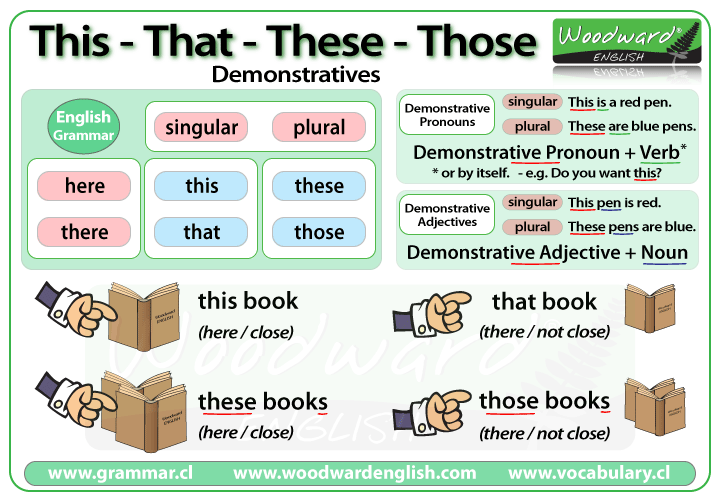
- Watch this video:

- 👉 Click here to watch
- Now do the exercises on the right sidebar. 👉
- The rule is this:

- Complete the stories using Simple Past and Past Continuous. 👉
3/7
Hello!
Today we are adding some exercises to revise -ED and -ING adjectives.
Sometimes, you don´t use them well, and they are necessary for your speaking and writing production.
SOMEBODY IS ..................... - ED IF SOMETHING IS ..................... - ING

Continue practising what you haven´t practised yet.
Remember to scroll down!

30/6
Hi! Remember you must be revising and practising all the grammar structures we have been working with in class up to now. Besides, you have to revise the ones you still don´t know and you learnt in previous years.
There are plenty of exercises on the right sidebar. 👉

- The week before the last one, we told you not to forget to revise for activities we were going to set on FRIDAY, 23RD JUNE. You were supposed to study them. Some of you didn´t do it. Do it as soon as possible! - Verb tenses - Simple Past and Present Perfect (Affirmative, negative, and question forms) - Past Participles - Time words to use with Present Perfect - Reported Speech (Statements and Commands) - Extreme adjectives
- You have a Topic related to Space to read about and talk about in class on Wednesday after the holidays. 👈 There are search engines for kids on the left sidebar.
- There will be a Complete Mock after the holidays. Revise for Speaking and Writing. Go to "B1 PRELIMINARY" page. 👆 Don´t forget to scroll down!



Wednesday, June 8th
MONTHLY TEST
Thursday, June 16th
What to revise:
- Simple Present (Affirmative, negative, and question forms)
- Simple Past (Affirmative, negative, and question forms)
- -ED and -ING Adjectives
- 0 Type Conditional
- say / said - tell / told
- There is / It is - There are / They are
- Countable and Uncountable Nouns
- How much/How many
- some /any /no
- should /shouldn´t
- and / but / so / because
- Question Tags
Tuesday, May 10th
Let´s start revising SIMPLE PAST.
Practise: Regular and irregular verbs

Play these games. 👉 Click here



REVISION: FINAL EXAM - LANGUAGE

NORMANS
Who were the Normans and where did they come from?
The Normans were a group of people who descended from the Norwegian Vikings. They came to settle in the north of France. As a result, the Normans were made up of Vikings and native people to the region.
From the eighth century, Vikings terrorized continental European coastlines with raids and plundering, and that's initially how the Normans started out. However, During the later 9th century their raids on the northern and western coastlands of France grew in scale and frequency, and the Vikings had secured a permanent foothold on Frankish soil in the valley of the lower Seine River by about 900. Over time, the region began to become known as "Normandy", based on a simplified version of "Norsemen", as the Vikings became increasingly established in the region, and cultural exchange between both groups became more common. Finally, things became formalised: the Normans' right to their new territory was officially established by a 911 treaty between King Charles III of West Francia and Rollo, the leader of the Vikings.
Under this agreement, known as the Treaty of Saint-Clair-sur-Epte, Charles granted land along the lower Seine river in return for Rollo’s assurances that his people would defend the area from other Vikings and that they would convert to Christianity.
The territory allocated to the Normans was then expanded by Rudolph, King of France, and within a few generations a distinct “Norman identity” had emerged — the result of the Viking settlers intermarrying with the so-called “native” Frankish-Celtic population.In the later part of the 10th century, the region began to take the shape of a duchy, with Richard II becoming the area’s first duke. Richard was the grandfather of the man who would later become the most famous Norman of them all: William the Conqueror.

What were the Normans famous for?
The Normans have made a name for themselves in history for several interesting reasons. As a result, they make for an engaging topic and one that children will really enjoy.
They are well known for their invasion of England during the 11th century. And, later during the 12th century, they went on to invade Ireland.
The Norman Conquest, as it’s known, was first led by the Norman ruler William the Conqueror who eventually became the King of England. The most famous battle to take place during their conquest was the Battle of Hastings in 1066.
Luckily for historians, this battle was documented on the Bayeux Tapestry which has helped piece together the events with great detail and accuracy. It has also given us an insight into the Norman ways of life. We can see from the tapestry what Norman people wore and the types of homes they lived in.
The Normans are also famous for their motte and bailey castles, many of which can still be seen around England and Ireland today.
And finally, you may have heard of the Domesday Book. This was a huge census ordered by William the Conqueror in 1086 to assess taxes and land-ownership in England - the first earliest public record of this kind in British history! It has taught us a lot about Norman history and is one of the biggest records of its time and long afterwards - it was the largest survey of this type until 1873.

REVISION FOR THE FINAL EXAMS: HISTORY, THE NORMANS


REVISION FOR THE MONTHLY TEST
Hi guys! Here you have some materials to practice, have fun! 😀

ZERO CONDITIONAL:
QUESTION TAGS:
https://es.liveworksheets.com/lm1948641zb
https://es.liveworksheets.com/worksheets/en/English_language/Question_Tags/Question_Tag_bs1429009js
VERB TENSES:
QUESTIONS:
PREPOSITIONS OF DIRECTION:
https://es.liveworksheets.com/im232666ex
MONTHLY TEST 12/11

To study:
Vocabulary: means of transport
Grammar points:
- Verb tenses
- Questions
- Question tags
- Zero conditional
- Prepositions of direction
Good luck 🤞🏼

REVISION QUESTION TAGS
Hi guys! Here you have some exercises to practice 😀

2- https://es.liveworksheets.com/worksheets/en/English_language/Question_tags/Question_tags_bd779203tq
Maru and Mariana 👋

26/8: REVISION FOR THE TEST
Hi guys! Here you have some exercises to practice for the language test!

Good luck 🍀😀
Maru and Mariana
PREPOSITIONS OF TIME: https://es.liveworksheets.com/rf1232240lr
RELATIVE PRONOUNS: https://es.liveworksheets.com/worksheets/en/English_as_a_Second_Language_(ESL)/Defining_Relative_Clauses/Defining_Relative_Clauses_if951776vj
TELLING THE TIME: https://es.liveworksheets.com/worksheets/en/English_as_a_Second_Language_(ESL)/Telling_the_time/What_time_is_it$_xt177763ga
WH QUESTIONS: https://es.liveworksheets.com/worksheets/en/English_as_a_Second_Language_(ESL)/Question_words/Question_Words_yo25808ft
SIMPLE PAST: https://es.liveworksheets.com/worksheets/en/English_as_a_Second_Language_(ESL)/Past_simple/Past_simple_tense_dc110kf
SIMPLE PRESENT AND PRESENT CONTINUOUS: https://es.liveworksheets.com/worksheets/en/English_as_a_Second_Language_(ESL)/Present_simple_and_present_continuous/Present_Simple_vs_Present_Continuous_kd1117924ls
COMPARATIVES AND SUPERLATIVES:https://es.liveworksheets.com/worksheets/en/English_as_a_Second_Language_(ESL)/Comparatives_and_superlatives/Comparative_and_superlative_zy1326sp
LANGUAGE TEST 30/8

Hi guys, here you have the topics you will have to study for the language test. THE TEST WILL TAKE PLACE ON MONDAY, AUGUST 30th.
REMEMBER THAT ALL THE MATERIALS ARE IN YOUR GREEN COPYBOOKS AND HERE ON THE BLOG
-Simple present / present continuous
- Simple past
- Questions
- Adverbs of frequency
- Comparatives / superlatives
-Relative pronouns (WHO- THAT- WHERE)
- The time
- Prepositions of time (AT - IN - ON)
Good luck! 🍀
Maru and Mariana
19/8: HISTORY TEST
Hi guys! Here you have some useful material for tomorrow's test! Have fun!
REMEMBER THAT ALL THE MATERIAL IS IN YOUR HISTORY COPYBOOK AND HERE ON THE BLOG.

Who were the Vikings?: https://www.youtube.com/watch?v=3xIy7FoiaQY
Take a look at this interactive website in which you can see a Viking house from the inside!
VIKING HOUSE (CLICK HERE)
Viking warriors: https://www.youtube.com/watch?v=pKE2SFR6Vos
An incredible Viking voyage: https://www.youtube.com/watch?v=eGLu2Frqwis